

What do Students Actually Gain from a Faculty-Led Cultural Immersion Experience?
Internationalizing education through real-world learning abroad is a priceless opportunity for students, across areas of study, countries and beyond. Faculty-led cultural immersion is a singular opportunity for students to apply in practice, in a foreign environment and understand the layers and intersectionality of how their learning impacts, not only their everyday environment, but also how it impacts another society entirely different from their own reality.
In this blog we’ll review was is cultural immersion, how it works in faculty-led cultural immersion, and how the outcome builds global competency students setting them up for their future, by reviewing three faculty-led programs that took place in Japan one focusing on psychology, another focused on anime, and the last an intersectional look at creative writing & eastern religions.
What is Cultural Immersion in Faculty-Led Study Abroad?
Cultural immersion study abroad is much more than seeing the sights, it is the practice of actively engaging in the local life. It is experiencing first-hand the traditions that are authentic to everyday life, and results in building empathy for the local people.
Cultural immersion requires the participant to challenge what is known, normal, and expected from their daily life an experience an entirely different way of living. It involved using local language, developing connections to locals and understanding how they perceive their own lives, rather than how you do. It involves trying local cuisine, what is normal to them, and even active participation in community spaces. The result is creating students with global competency who are empowered to connect the classroom and real world, to gain deeper insights and understanding.
Cultural Immersion in Japan Through Traditional Tea Ceremony
Queens University of Charlotte went to Japan in May with Study Abroad Association, in this program their focus was on being Spirited Away, through experiencing the anime, art, and music of Japan.
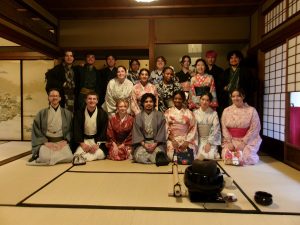
Participants went to Kyoto, where they had a cultural immersion experience through a tea ceremony, which is a significant part of Japanese culture that promotes harmony, respect, purity, and tranquility, creating bonding between the host and guest and gaining inner peace.
Japanese tea ceremonies are rituals, rooted in Zen Buddhism that transform hospitality into an art form, when participants at Queens University of Charlotte took part in the tea ceremony in Kyoto they were dressed in traditional kimono and decorated with accessories, kanzashi to fully immerse themselves from head to toe into the the culture of Japan.
Anime, Art, Nature, & Beyond
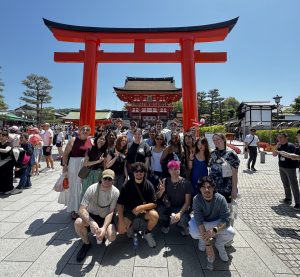
In addition to the tea ceremony, participants visited key sites in Tokyo, Kyoto, and more. They went to the Fushimi Inari Taisha Shrine highlighting the gates of the physical world from the spiritual world. They went to Todaiji Temple and Nara Deer Park seeing the intersection of religion and nature. In a visit to Fuji and Lake Kawaguchiko students visited the Kawaguchiko Music Forest where it displays antique music boxes and other musical instruments. Merchandise from Studio Ghibli, including Ghibli film-themed music boxes, can be found there!
Cultural Immersion Doesn’t Have a Timeline
One of the main barriers to study abroad is the time requirements, a semester abroad is a much more long term commitment than a few weeks, but that doesn’t mean that the level of immersion or the depth of learning is any less. With the participants from Queens University of Charlotte they had several key moments strengthened the cultural immersive experience. The tea ceremony highlights a unique opportunity to fully adapt to the customs, traditions, and place importance on the communications of an other culture that is entirely foreign to them while interacting with locals who live and breathe this experience in their daily life.
College Lake County in Japan Studying Psychology
Doing a 180 in the area of focus, we’re still in Japan, but this time participants from College Lake County dissect the scientific study of the human mind, brain, and behavior. Psychology explores how biological, cognitive, and social factors shape our thoughts, feelings, and actions.
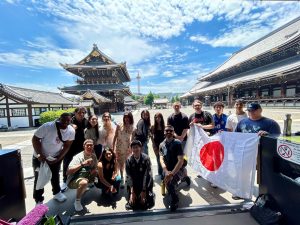
Participants visited key areas in Osaka, such as Shinsaibashi-Suji Street and Yamadeike Park, and academic spaces like the National Museum of Ethnology & Expo Park and KGU University; together, these experiences gave participants a holistic view of the social factors that influence daily life in Japan.
Participants also visited Hirakata T-Site, an epicenter of consumerism & social psychology in Osaka. This gallery space features a stylish multi-story complex blending books, cafes, shops, and lifestyle spaces. This modern hub offers a unique mix of culture, design, and relaxation in the heart of Hirakata.
In Kyoto, students visited Shirakawa Canal & Yasaka and explored the Nishiki Market. Here, they experienced the intersection of nature, tradition, and culture along a single scenic route. Juxtaposed by the energetic street filled with local foods, snacks, and traditional delicacies.
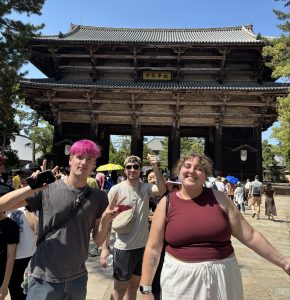
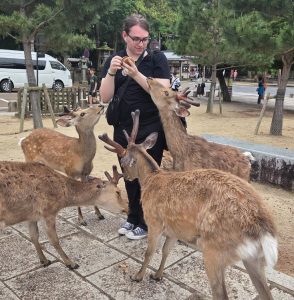
In Nara, participants immersed themselves not in human culture but in the animal world at Todaiji Temple & Deer Park, the park home to hundreds of freely roaming, friendly deer considered sacred in local tradition.
Cultural Immersion is multi-layered and multifaceted
Like psychology, cultural immersion is multi-layered and multifaceted. Particpants got a holistic immersions through this program, by visiting combinational elements, museums, parks, cultural epicenter and combined it creates a lasting impression and understanding of the experience with consideration to the area of focus.
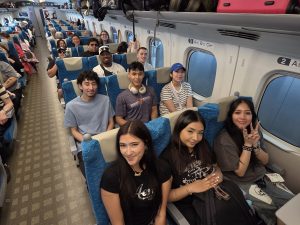
Psychology requires participants to examine society through an intersectional lens, considering how biological, cognitive, and social factors shape our thoughts, feelings, and actions. During their faculty-led program in Japan, participants from College Lake County
MiraCosta College in Japan Exploring Creative Writing and Eastern Religions
Throughout their program, MiraCosta participants have planned creative writing and Eastern religion classes; these scheduled lectures, coupled with an itinerary, reinforced their learning and knowledge throughout their program.
One of the most profound experiences of the program was a culturally immersive meditation at Zenkō-ji Temple; here, participants nestled in the serene landscapes of the Northern Japan Alps meditated among the temple’s tatami-matted atmosphere. Zenkō-ji, a Buddhist temple built in the 7th century, is one of the few remaining pilgrimage sites in Japan, offering a unique experience that is both sacred and highly authentic for visitors.
In addition to the transformative meditation session, participants visited key religious sites in Tokyo, such as Meiji Shrine, a Shinto Temple*, Tsukiji Hongan-ji, Asakusa, and cultural epicenters like Tsukiji Outer Market and Ginza.* As s, Buddhism is deeply connected to nature, participants leaned into the philosophy of interdependence and did a Hike in Kamikochi, visiting Hirayu Waterfall and Nara Deer Park.
Cultural Immersion Mirrors our Society & Our Learnings
MiraCosta’s program in Japan tied a thread across creative writing, eastern religions, pulling knowledge into a real-world sites and experiences. Through faculty-led cultural immersion, participants experienced a different way of life, another religion and lived in the society were it is normal and thus challenges their normal beliefs. At its core, cultural immersion in study abroad build empathy and understanding towards other culture, people, ways of life singular to our own. Participants from MiraCosta College, embraced this new experience, and adapted to other religions and explored its intersection in daily life.
Faculty-Led Cultural Immersion Experiences are Unlimited
We’ve seen here that within one country, across three programs that faculty-led cultural immersion is vast and varied but the end result is impact that lasts a life time, building empathy, fostering the development of global citizens and enriching international education for a lifetime.
Faculty-led cultural immersion is limitless in this respect, you can achieve the results across faculty-led programs of varying areas of study and countries. if you’re interested in create a custom faculty-led program, with a strong itinerary to support cultural immersion connect with us today and request a proposal!